

Adult Diapers for Bedridden Patients and Limited-Mobility Adults
Adult diapers for bedridden patients should be chosen around body position, changing access, wheelchair pressure, urine or bowel leakage, skin checks and the amount of help available—not around one absorbency number.
Use this guide to compare open-flat tabbed briefs, nighttime protection, bed and chair pads, caregiver setup and the point at which one person should stop and ask for help.
The brief has to work during the change—not only after it is fastened
A package stored across the room is not close enough when one hand is supporting a hip. A pull-on that looks familiar may still require full trouser removal and more leg movement than the person can comfortably manage. A tabbed brief may be easier on a flat bed, yet harder to position when a sling, chair arm or cushion blocks the caregiver’s hands.
This is why the best adult diapers for bedridden patients cannot be selected by absorbency alone. The useful questions are practical: Can the person turn? Can they hold a side-lying position? Is the rear waist reachable? Does the product stay in place after a transfer? Can one caregiver complete the task without lifting or overreaching?
The phrase hospital diapers for adults usually refers to open-flat adult briefs with tabs rather than a separate clinical category. What matters is side-panel reach, adjustment, containment, skin access and whether the brief can be removed without pulling it over the feet.
“Put the clean brief and disposal bag where your hands will need them before the first turn.”
Choose by Position, Changing Access and Caregiver Safety
These care checks connect product structure to the routine. They also help separate a fit problem from saturation, body position, skin exposure or an unsafe changing setup.
Body position
Note whether the person normally lies on the back, one side or changes position. Liquid travels differently in each position, and the usable core area changes with it.
Changing access
Decide whether the fresh product can be opened flat, slid into position and adjusted without removing all clothing or repeatedly lifting the legs.
Seated and wet-state fit
Check the rear waist, thighs, crotch and guards while seated and after absorption. A product can fit while dry and drop after the core becomes heavier.
Leak pattern
Record the first wet area and whether part of the core remains dry. Leg, rear-waist, side-sleeper and full-saturation leaks need different next steps.
Urine or bowel care
Heavy urine output calls for useful capacity and flow handling. Bowel care also needs broad rear coverage, standing guards, easy opening and prompt cleaning access.
Skin and communication
Consider surface dampness, sitting pressure, friction and whether the person can report discomfort. Nonverbal signs require a consistent observation routine.
Caregiver safety and available help
Product selection cannot make an unsafe lift safe. Identify the bed height, turning ability, equipment, working space and point at which a second person or trained help is required.
Choose the opening before choosing the absorbency tier
For bedridden and limited-mobility adults, a product must first be possible to apply, adjust, inspect and remove in the normal position.
Usually the first form to compare
Disposable briefs for bedridden adults can be opened flat and positioned without passing the product over the feet. Refastenable tabs allow separate waist and thigh adjustment after turning or transferring.
Best when the wearer can assist
A fresh pull-on must pass over both feet and legs. It may work for a wheelchair user who can stand or transfer safely, but it is usually less practical for a fully bed-based change.
Separate products for separate jobs
A body-worn pad may suit light leakage when fitted underwear holds it securely. A bed pad protects the surface. Neither is a direct substitute for a full brief when broad urine or bowel containment is required.
Check adult diapers for bedridden patients in the position where they must work
Body position changes cuff contact, pressure, rewet, core placement and liquid direction. A standing fit check is not enough for adults who spend most of the day sitting or lying down.
| Position or movement | What can change | What to check | Useful next step |
|---|---|---|---|
| Back lying | Liquid moves toward the rear while the waistband and rear core carry more of the load. | Rear rise, rear coverage, waistband contact and whether the brief slides after turning. | Compare an adjustable overnight tab brief with stable rear coverage. |
| Side lying | Liquid moves away from the center core and one leg seal carries more pressure. | Normal sleep side, guard position, side gaps, core width and the first wet area. | Use the side-sleeper guide before assuming more capacity is needed. |
| Wheelchair sitting | Sitting pressure can compress the core, increase surface rewet and lower the rear waist. | Fit while seated, crotch position, rear drop, skin after sitting and changes after transfers. | Recheck the product after a normal period of sitting and absorption. |
| Turning and transfers | The chassis can rotate, tabs can loosen and a surface pad can bunch beneath the body. | Waist, thighs, guard direction and whether the bed or chair pad remains flat. | Use refastenable tabs and a correctly sized surface pad. |
A shorter reach can be more useful than a faster hand
The task becomes harder when a caregiver has to keep the person supported while searching for a clean brief, cleansing supply or disposal bag.
Place supplies within comfortable reach
Keep the clean brief, cleansing supplies, disposal bag, clean clothing or linens and surface protection on the working side. Avoid placing essentials behind the caregiver or across the bed.
Open and identify the product first
Unfold the brief, identify front and rear, and confirm that the standing guards are not folded inward before supporting the person through a turn.
Use the smallest safe movement
The goal is not to complete a large turn quickly. Follow the care plan, use equipment correctly and keep the person supported throughout the movement.
Recheck in the final position
Check the rear waist, thigh contact, crotch position, tabs and surface pad after the person returns to the normal lying or sitting position.
One caregiver should not have to turn every change into a solo lift
A caregiver-friendly brief can reduce complete undressing and repeated repositioning, but it cannot make an unsafe transfer safe. Stop when the person cannot assist, the caregiver cannot maintain balance, the bed is too low or unstable, or a turn requires force.
A larger body, paralysis, joint stiffness, pain, a sling lift or a narrow working area may require a second person, a positioning aid or professional instruction. The correct limit depends on the care plan and equipment available.
For extended waist ranges, compare the BariFit Plus Size Adjustable Brief and use the adult diaper size chart and fit guide before ordering a full case.
The most comfortable product is not defined by softness alone
Fit, surface dampness, sitting pressure, friction, bowel contact and change timing all affect how a product feels during bed or wheelchair care.
Sitting or lying pressure can bring moisture back toward the surface. A brief that is too tight, folded, twisted or sagging can add friction even when the outer material feels soft.
Change after bowel soiling and when the product is saturated, leaking, uncomfortable or associated with persistent dampness or skin concerns. Do not use a fixed eight-, ten- or twelve-hour statement as the only change schedule.
Check the skin where the waistband, thighs, crotch and bed or chair surface make contact. Continue with the adult diapers for sensitive skin guide when moisture, friction, pressure or materials are the main concern.
For general skin-care boundaries, see MedlinePlus guidance on skin care and incontinence .
Bowel containment needs coverage and cleaning access
For bowel or mixed urinary and bowel incontinence, compare a full-coverage tabbed brief with tall standing guards, broad rear coverage and tabs that can be opened without pulling the product over the legs.
Bowel soiling should be addressed promptly. A product designed for heavy urine output may still be unsuitable if it provides poor rear containment or makes cleaning difficult.
Browse adult diapers for bowel incontinence and review NIDDK information about fecal incontinence treatment and care .
Look for a change from the person’s usual pattern
Behavior can signal that something needs to be checked, but it should not be treated as proof of one cause.
Pulling or guarding
Pulling at the waist or thighs, repeated touching, guarding one side or resisting sitting.
Sagging or twisting
A dropped rear waist, folded guards, a twisted chassis or an underpad bunched beneath the body.
Visible or indirect clues
Damp clothing, a wet chair or bed surface, a new odor or a product that appears swollen.
A meaningful change
Redness, pressure marks, restlessness or withdrawal that differs from the person’s normal behavior.
Compare products for bed changes, nighttime, heavy output and surfaces
These products represent four different jobs. Start with the problem that needs to be solved rather than treating them as interchangeable layers or a universal ranking.
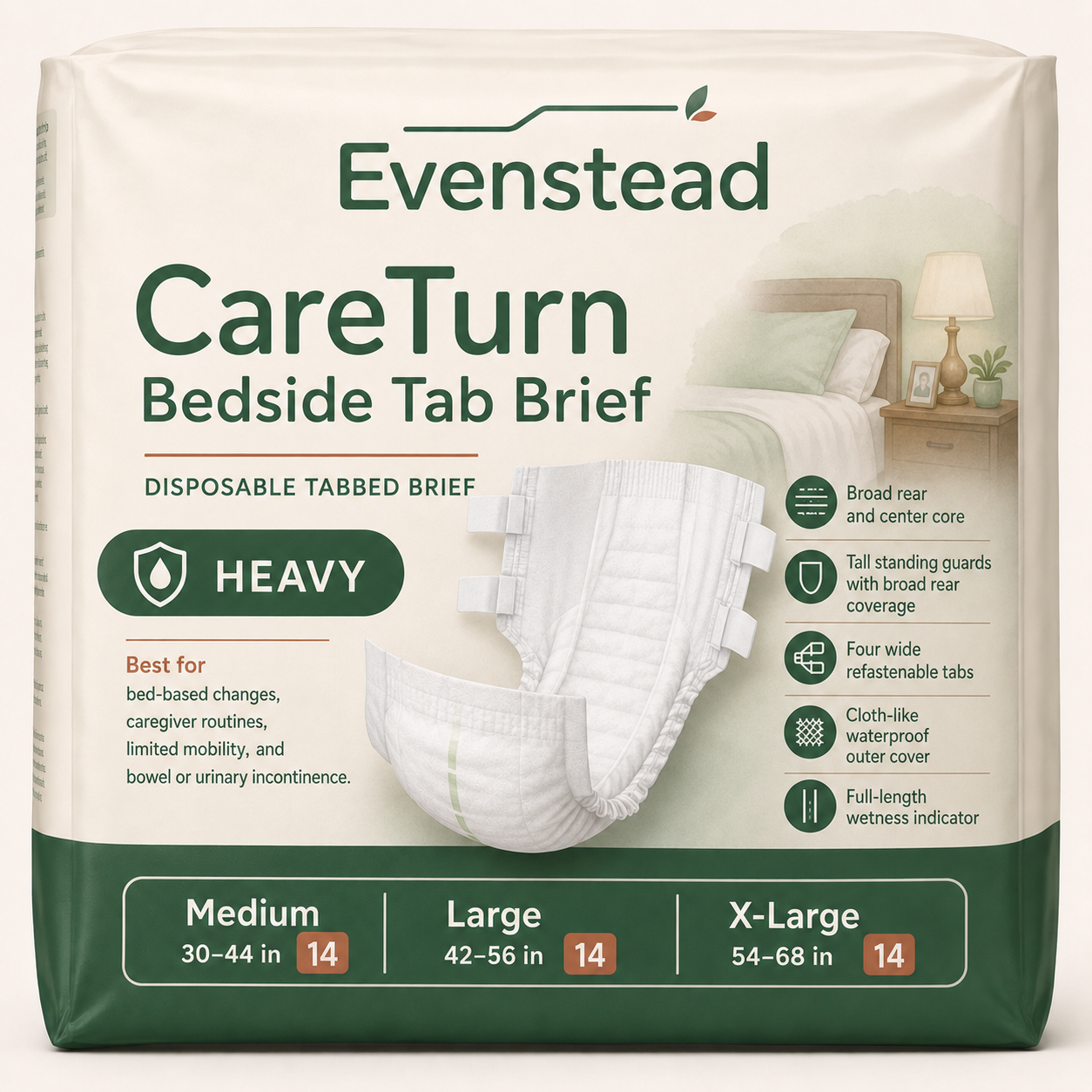
Evenstead CareTurn Bedside Tab Brief
Best match: Open-flat application, limited mobility and caregiver-led urinary or bowel care.
Choose for access and adjustment. It does not replace timely changes, safe repositioning or regular skin observation.
View product
Evenstead NightShield Overnight Tab Brief
Best match: Long nighttime routines that need adjustable fit and greater rear-waist coverage.
Check sleep position, rear rise, saturation and skin condition rather than using a fixed number of hours as the change rule.
View product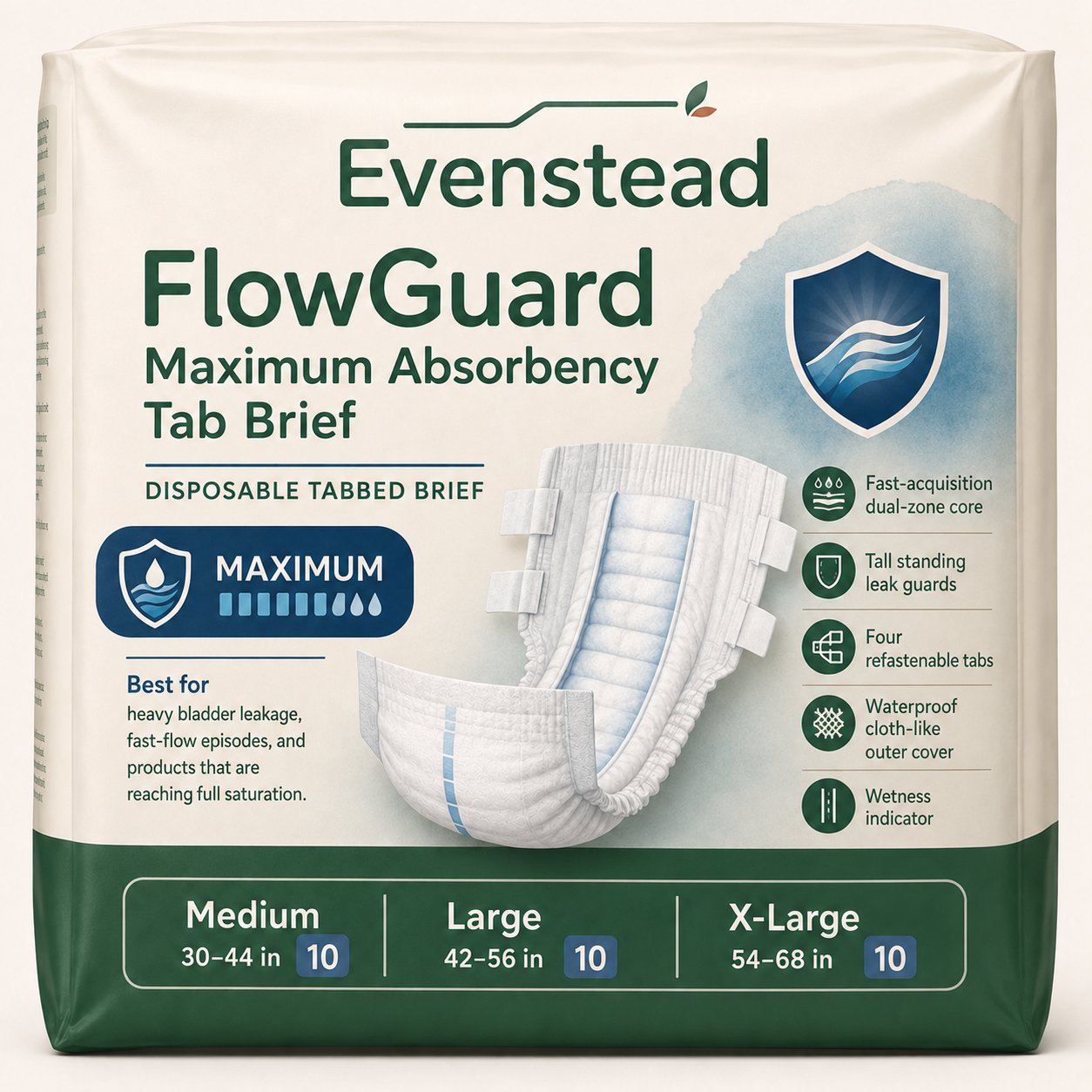
Evenstead FlowGuard Maximum Absorbency Tab Brief
Best match: A correctly fitted brief that reaches full capacity too quickly.
Higher absorbency can help with saturation. It cannot correct loose thighs, insufficient rise or rotation during transfers.
View product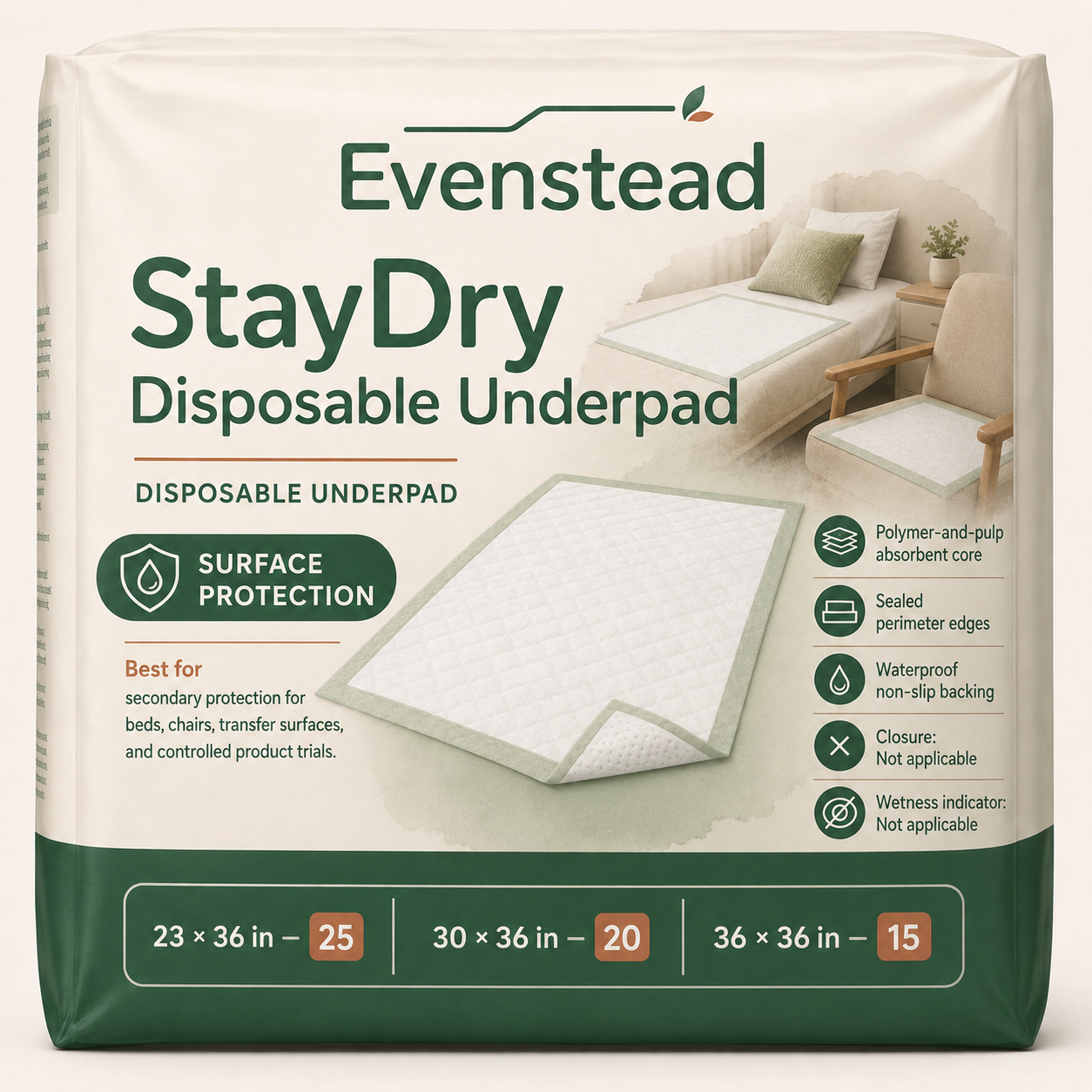
Evenstead StayDry Disposable Underpad
Best match: Secondary protection for beds, chairs, transfers and controlled product trials.
An underpad protects the surface. Keep it flat beneath the person; never fold it into the wearable brief.
View productChoose hospital bed pads as a separate layer
Searches for reusable hospital bed pads and disposable underpads often mix several products. The useful comparison is disposable convenience versus washable rotation.
| Surface protection | Useful for | What to check | Limit |
|---|---|---|---|
| Disposable underpads | Quick changes, travel, temporary routines and backup during a product trial. | Dimensions, waterproof backing, sealed edges and whether the pad stays flat. | Single use; can bunch during transfers and does not correct wearable fit. |
| Reusable hospital bed pads | Long-term home care when laundry and drying capacity are available. | Wash instructions, drying time, shrinkage, backing grip and how many are needed in rotation. | A wet pad must be replaced; one pad cannot be washed, dried and reused immediately. |
| Reusable chair pads | Wheelchairs, recliners and dining chairs when size and movement are controlled. | Seat dimensions, thickness, edge placement and movement during transfers. | Should not create a ridge or unstable sitting surface. |
Continue with the guide that matches the next problem
Mobility, fit, leakage, changing technique and skin each need a closer look.
Choose by mobility, dressing ability, toileting, nighttime routine and participation.
Read the senior guideMeasure waist and hips, then check thighs, rise, seated fit and wet-state sag.
Read the size guideTroubleshoot leaks at the legs, rear waist and sides before increasing absorbency.
Read the leak guidePrepare supplies and compare standing, bed-based and assisted changes.
Read the changing guideSeparate moisture, friction, pressure, fit and material concerns.
Read the skin guideCheck side gaps, core coverage, sleep position and secondary protection.
Read the side-sleeper guideBrowse by product need
Open-flat and refastenable products for assisted and bed-based changes.
Browse tabbed briefsCompare rear coverage, body position, useful capacity and skin observation.
Browse overnight productsFor a correctly fitted product that reaches saturation too quickly.
Browse heavy protectionCompare full coverage, guards, rear containment and cleaning access.
Browse bowel protectionSingle-use protection for beds, chairs, transfers and temporary routines.
Browse disposable padsWashable surface protection for homes with a planned laundry rotation.
Browse reusable padsSupporting articles
Understand care routines and the supporting role of absorbent products.
Read articleReview moisture, friction, pressure and change timing.
Read articleConnect nighttime leaks, changing demands and repeated sleep disruption.
Read articleCompare price per piece with laundry, failed changes and caregiver time.
Read articleA product can manage leakage; it cannot explain a sudden change
Seek professional guidance for new or rapidly worsening incontinence, pain, blood in the urine, fever, difficulty urinating, new neurological symptoms or serious or persistent skin damage.
Product selection should connect to the person’s care plan, mobility and available help. Do not reduce fluid intake without appropriate guidance simply to reduce product use.
Adult Diapers for Bedridden Patients FAQs
Which adult diapers are easiest for bedridden patients?
Are pull-ups suitable for someone who cannot stand?
How does wheelchair pressure affect adult diapers?
Can an adult stay in an overnight diaper for 12 hours?
What supplies should caregivers keep near the bed?
When should one caregiver stop and ask for help?
How can caregivers tell whether a nonverbal adult is uncomfortable?
Are bed pads a replacement for adult diapers?
Are reusable hospital bed pads better than disposable underpads?
What is the best adult diaper for bowel incontinence in bed?
Should a booster pad be added for a bedridden adult?
How should adult diapers for wheelchair users be fitted?
Choose a product the caregiver can apply, the wearer can tolerate and the care plan can support
Begin with body position, movement and who performs the change. Then check fit, leakage, skin and surface protection as separate parts of the routine.